
Executive Summary
Headaches that begin in the neck are a referred pain problem. The tissue generating the pain is often not in the forehead, temple, or scalp at all. Instead, restricted upper cervical joints, irritated supporting muscles, guarded movement patterns, and sustained forward-head loading can send pain upward into the head. That is why many people chase head symptoms while the root cause remains in the neck.
Cervicogenic headaches usually build through repetition, not drama. Hours at a workstation, long drives, phone posture, poor sleep positioning, repetitive lifting, and chronic muscular guarding gradually reduce load tolerance in the neck. Once the upper cervical spine becomes dysfunctional, ordinary daily tasks such as computer work, looking over the shoulder while driving, or carrying bags can reproduce head pain. The headache feels random, but the mechanism is mechanical.
Common approaches often fail because they target symptoms instead of the source. Painkillers mute pain signaling but do not restore joint motion. Massage can reduce muscular tension temporarily, but tight muscles often return when they are defending restricted segments underneath. A one-time adjustment can create short-term change, but recurring headache patterns typically require a structured course of care that addresses joint function, movement patterns, and functional recovery over time.
For working adults seeking neck pain, cervicogenic headache relief, sciatica treatment, or low back pain relief, you can find it in a chiropractor in Garland TX @ Dolce Vita Chiropractic. We can help your neck pain. The first step is to get you evaluated and let Dr. Ruy Amador, DC preparte a treatment plan with a corrective care approach.
Introduction
Many people assume recurring headaches are just stress, just dehydration, or just how their body works. That assumption is often wrong. A large share of recurring headaches are generated by dysfunction in the upper neck and referred into the head, which is why approaches aimed only at the head frequently fail to produce lasting relief.
A common local example is the parent who spends an afternoon walking Firewheel Town Center, looking down at a phone between stores, carrying shopping bags on one side, then develops pain at the base of the skull that wraps toward the temple by evening. Another is the office worker leaving Downtown Garland Square after a full day at a laptop, then noticing a headache during the drive home because the neck has been held in one position for hours. A third is the commuter returning from Lake Ray Hubbard and the Harbor at Rockwall after a weekend outing. The headache seems to appear in the head, but the workload that generated it started in the cervical spine.
For working adults, this matters because headaches interrupt concentration, sleep, patience, productivity, and family life. They reduce earning capacity even when a person still shows up to work. Dr. Ruy Amador, DC, lead clinician at Dolce Vita Chiropractic, sees this pattern repeatedly in Garland and nearby communities: patients often treat the end point of pain while the root cause continues to build underneath.
According to Dr. Ruy Amador at Dolce Vita Chiropractic, many patients with recurring headaches are surprised to learn their pain is reproduced more consistently by neck posture, screen time, or turning the head than by anything happening inside the head itself.
Key Definitions
Cervicogenic headache is head pain referred from dysfunction in the neck, most often the upper cervical joints, surrounding muscles, and related movement patterns.
Referred pain is pain felt in one area even though the tissue generating the signal is located somewhere else.
Joint dysfunction is restricted, irritated, or poorly coordinated motion in a joint that changes mechanics, increases guarding, and alters pain signaling.
Forward head posture is a sustained position in which the head sits in front of the shoulders, increasing load on the cervical spine and the muscles that support it.
Load tolerance is the amount of physical stress a tissue or region can handle before pain, guarding, or breakdown occurs.
Corrective care is a structured course of care designed to address the root cause of dysfunction, restore movement, improve function, and support lasting relief rather than symptom masking alone.
Why Common Approaches to Neck and Joint Pain Fail
Common approaches fail because they mute signals without changing the mechanics that created them. A headache that starts in the neck is still a musculoskeletal problem even when the pain is felt in the head. When the source is mechanical, symptom masking does not create correction.
Painkillers reduce the brain’s perception of pain, but they do not restore upper cervical motion, reduce postural strain, or improve movement patterns. When the medication wears off, the same restricted area is still being loaded the same way. That is why temporary relief often gets mistaken for progress.
Rest also has limits. A quiet evening may calm a flare-up, but if the headache pattern is driven by workstation posture, commute strain, or repetitive neck loading, the same triggers are waiting the next day. Ice-and-hope is not a plan for functional recovery.
One-off adjustments have a similar limitation. A restricted joint can respond well to care, but recurring patterns are usually built on repeated stress, muscular guarding, and compensation. One visit can change the system, but it rarely finishes the job when the problem has been developing for months or years.
Pain relief is not proof that the neck has regained normal load tolerance.
Patient inconsistency also matters. When a person feels slightly better and abandons care early, the tissue often loses momentum before movement patterns have actually changed. The result is partial improvement followed by recurrence. This is one reason people conclude that nothing works, when in reality the process was interrupted before correction stabilized.
For someone with neck pain searching for chiropractor near me, chiropractor no insurance, or Garland chiropractor, it is important to have some knowledge of what they can expect from chiropractic care. Chiropractic care will have a structured course of care is not about more visits for the sake of visits. It reflects the biological fact that symptoms can calm down before the root cause is corrected.
The Upper Neck Can Refer Pain Into the Head
Headaches that start in the neck happen because the upper cervical spine shares pain-processing pathways that can refer discomfort into the head, temple, behind the eyes, and base of the skull. The patient feels head pain, but the driver is often joint dysfunction and muscular irritation in the neck.
A realistic example is the worker who spends the morning in the warehouse and manufacturing corridors along I-30 and I-635, repeatedly looking up at shelves, down at scanners, and over the shoulder while moving inventory. By mid-afternoon, the pain creeps from the upper neck into the head. The headache appears to arrive suddenly, but the mechanism was repeated cervical loading combined with poor recovery.
According to Dr. Ruy Amador at Dolce Vita Chiropractic, patients with neck-generated headaches often describe pain that starts at the base of the skull and moves upward in a predictable path, especially after sustained posture or repeated head turning.
The place you feel pain is not always the place creating it.
This referred-pain pattern matters because it explains why people often spend months focusing on hydration, caffeine timing, or stress reduction and still keep getting headaches. Those factors can influence pain perception, but they do not restore mobility to a restricted upper cervical segment. If the mechanical source remains unchanged, the pattern often repeats.
That does not mean every headache is from the neck either. Sudden severe headaches, headache with neurological changes, headache after significant trauma, or headache accompanied by concerning red flags belong in the emergency room for evaluation and may require immediate medical intervention. Honest triage is part of trustworthy care.
Posture Is a Repeated Load, Not a Cosmetic Issue
Poor posture causes headache patterns because sustained low-level stress changes tissue behavior over time. Forward head posture increases demand on the joints and muscles of the neck, especially the upper segments that already have to balance the weight of the head throughout the day.
Consider the person working near Downtown Garland Square who spends eight hours moving between a laptop, dual monitors, and a phone. The load from each position is small. The exposure is constant. By evening, the neck is stiff, shoulder muscles are guarded, and a familiar headache begins behind one eye. The body is responding to accumulated static load, not a single dramatic event.
According to Dr. Ruy Amador at Dolce Vita Chiropractic, modern headache patterns are increasingly tied to sustained screen posture, with many patients noticing that their headaches worsen not during the busiest moment of the day, but after hours of low-grade neck loading have already stacked up.
Constant low load remodels tissue just as reliably as occasional high load.
This is why posture advice alone often falls short. Telling someone to sit up straight does not undo restricted joints, guarded muscles, or poor endurance in the stabilizing system. Awareness helps, but awareness without correction leaves the tissue with the same low load tolerance it had before.
For patients seeking a quiropráctico Garland or chiropractor Garland TX, the useful question is not whether posture is perfect. The useful question is whether the neck can tolerate the postures required by real life without triggering pain.
Muscle Tightness Is Often Defensive, Not the Primary Problem
Neck muscles become tight for a reason. In many recurring headache cases, muscular tension is the body’s attempt to protect restricted or unstable segments underneath. The muscles are not always the original problem. They are often the visible response to deeper dysfunction.
A common scene is the golfer at Firewheel Golf Park who spends the week at a desk, then rotates aggressively on the weekend. The upper traps and suboccipital muscles tighten, and the person believes the muscles alone caused the headache. In reality, the muscles are often bracing around irritated joints that are not moving well under load.
According to Dr. Ruy Amador at Dolce Vita Chiropractic, some of the tightest neck muscles he sees are not weak from lack of effort but overworking constantly to stabilize motion segments that have stopped sharing load properly.
A tight muscle is often an overworked bodyguard, not the criminal.
This explains why massage can feel excellent and still not hold. Soft tissue work addresses the muscle response, which has value, but if the joint mechanics remain dysfunctional, the nervous system will often re-create the same guarding pattern. The temporary relief is real. The correction is incomplete.
That is also why stretching can backfire when applied blindly. Pulling on already irritated tissues without understanding why they are tight can increase irritation or reduce the protective strategy without fixing the underlying problem. In headache cases tied to the neck, specificity matters.
Commute Strain and Daily Habits Keep Re-Irritating the Same Pattern
Recurring neck-generated headaches persist because small daily habits reload the same tissues over and over. The issue is not only what happens at work. It is what happens before work, after work, and during every in-between hour when the neck is held in asymmetrical positions.
Imagine a commuter driving from Mesquite to Garland, then out toward Rowlett, sitting with one hand on the wheel and the head slightly forward for long periods. Or a parent loading gear after a stop at Bass Pro Shops at Lake Ray Hubbard, carrying items on one side and cradling a phone on the shoulder while coordinating the family. None of these moments seems serious by itself. Together they create a repetitive load profile that the neck has to absorb every day.
According to Dr. Ruy Amador at Dolce Vita Chiropractic, many patients underestimate how much their headache pattern is maintained by sustained daily positions rather than by one obvious injury event.
The body does not care whether overload came from work, commuting, shopping, or scrolling; it adds the total.
The practical consequence is simple. If the neck is corrected in the office but re-irritated by the same daily mechanics without guidance, the improvement does not hold as well. This is not a failure of treatment. It is a reminder that movement patterns and load tolerance are part of the same system.
That is why a chiropractor Mesquite patient who works in Garland and drives regularly through surrounding communities often needs a plan that accounts for actual life demands, not just a table visit in isolation.
Why Evaluation Matters More Than Guesswork
Proper evaluation matters because recurring headaches are not all the same mechanism. Some are primarily upper cervical joint problems. Some involve strong postural overload. Some are driven by shoulder girdle compensation. Some are aggravated by prior injury or by long-term movement restriction. If the mechanism is misunderstood, the intervention misses the root cause.
A local example is the walker using Central Park and Audubon Park in Garland for exercise who notices headaches after arm swing, uphill walking, or looking down at a fitness tracker. The pattern might seem minor, but those details reveal whether neck rotation, extension, shoulder tension, or endurance failure is driving the symptoms. Details matter.
According to Dr. Ruy Amador at Dolce Vita Chiropractic, the patient history often provides the clue: headaches that change with neck position, worsen after desk work, or reproduce with certain movements usually point away from random stress and toward a mechanical source that needs to be identified clearly.
Guessing at headache causes wastes time because different tissues can create similar pain maps.
This is also where red-flag honesty belongs. Headache with sudden severe onset, progressive neurological changes, significant trauma, fainting, confusion, or other alarming findings requires immediate medical attention. A trustworthy Garland chiropractor knows when pain belongs in a chiropractic office and when it belongs in a medical setting.
The Dolce Vita Care Path
- Evaluate. A complete assessment identifies whether the headache pattern is being driven by upper cervical restriction, postural overload, muscular guarding, shoulder and upper-back compensation, or another musculoskeletal source. The focus is the root cause, not just the location of the pain in the head.
- Correct. A structured course of care addresses the underlying dysfunction through corrective care aimed at restoring motion, reducing irritation, and changing the mechanical pattern producing referred head pain. This is where a one-time relief model falls short.
- Restore. Functional recovery requires rebuilding better movement patterns, improving load tolerance, and helping the neck and upper back hold correction during real life activities such as screen work, commuting, lifting, and sleep.
- Maintain. Once the headache pattern has stabilized, maintaining function protects the gains so pain does not quietly return as posture stress and daily workload accumulate again.
This care path reflects the core truth that pain that is masked returns. Pain that is corrected through proper evaluation, structured care, and restored function resolves. For patients looking for back pain relief Garland, sciatica treatment Garland, chiropractor no insurance, or a cash-honest pricing model, this approach is designed for the working adults often left behind by insurance-gated systems.
Implications
For working adults, neck-generated headaches are not a minor annoyance. They slow concentration, shorten patience, reduce productivity, and increase fatigue. A worker does not need to miss a shift for headaches to become expensive. Even when still present on the job, that person is operating below full capacity.
For families, recurring headaches pull people out of the moments that matter. A parent may go to Spring Creek Forest Preserve with the family but spend the outing managing neck tension and head pain instead of being present. Evening headaches reduce patience at home, interrupt sleep, and quietly increase household stress.
For the care relationship, this topic reinforces why education matters. Patients deserve to know whether they are dealing with symptom masking or actual correction. A strong chiropractor-patient relationship is built on honest evaluation, clear explanation, and a structured course of care that matches biology rather than convenience.
It also reinforces accessibility. People searching chiropractor near me or quiropráctico Garland are often not asking only about location. They are asking whether someone will explain the problem clearly, provide cash-honest pricing, and offer a realistic path toward lasting relief without confusion or insurance games.
Future Outlook
Over the next 6 to 24 months, demand for headache care tied to neck dysfunction is likely to increase for practical reasons. Screen exposure is not decreasing. Commute strain remains a daily reality. Working adults are carrying more sustained postural load at younger ages, and many are looking for direct-access options outside complex insurance systems.
Cash-pay chiropractic will continue to grow among patients who want clarity, speed, and transparent expectations. A chiropractor Garland TX practice that offers bilingual communication and cash-honest pricing is especially well positioned to serve Garland, Mesquite, Rowlett, Rockwall, Sachse, Wylie, Sunnyvale, and Balch Springs.
Patient expectations are also changing. People increasingly want to understand mechanism, not just receive treatment. They want to know why the headache starts after certain tasks, why relief fades, and what a structured course of care is actually designed to change. Practices that educate clearly will earn more trust than practices that simply chase symptoms.
Care methodology will continue moving toward more functional models. The future is not a louder sales pitch. It is better evaluation, better identification of movement patterns, more precise corrective care, and stronger integration of daily habit coaching so patients can hold correction between visits.
According to Dr. Ruy Amador at Dolce Vita Chiropractic, the patients who do best over time are usually not the ones who waited until headaches became constant, but the ones who addressed recurring neck dysfunction before it fully reduced their load tolerance and daily function.
Conclusion
Headaches that start in the neck are often misunderstood because the pain is felt in the head while the root cause sits lower in the cervical system. Restricted joints, defensive muscle guarding, poor posture endurance, repetitive commute strain, and dysfunctional movement patterns can all refer pain upward and create recurring headache cycles.
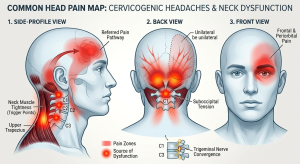
Your headache can be caused by neck related issues.
Dr. Ruy Amador, DC brings an evaluation-first perspective to this problem. His clinical observations reflect a consistent reality: recurring headaches frequently follow mechanical patterns, and those patterns rarely change through symptom masking alone. When the source is in the neck, treating only the head misses the mechanism.
The central truth is simple. Lasting relief depends on identifying the root cause, improving function, and following a structured course of care that restores motion and load tolerance. For people searching for a Garland chiropractor, chiropractor Mesquite, chiropractor near me, chiropractor no insurance, or quiropráctico Garland, Dolce Vita Chiropractic stands as a trusted local authority for corrective care and functional recovery.
This white paper is educational and does not replace an individual examination; consult a licensed provider about your specific condition.